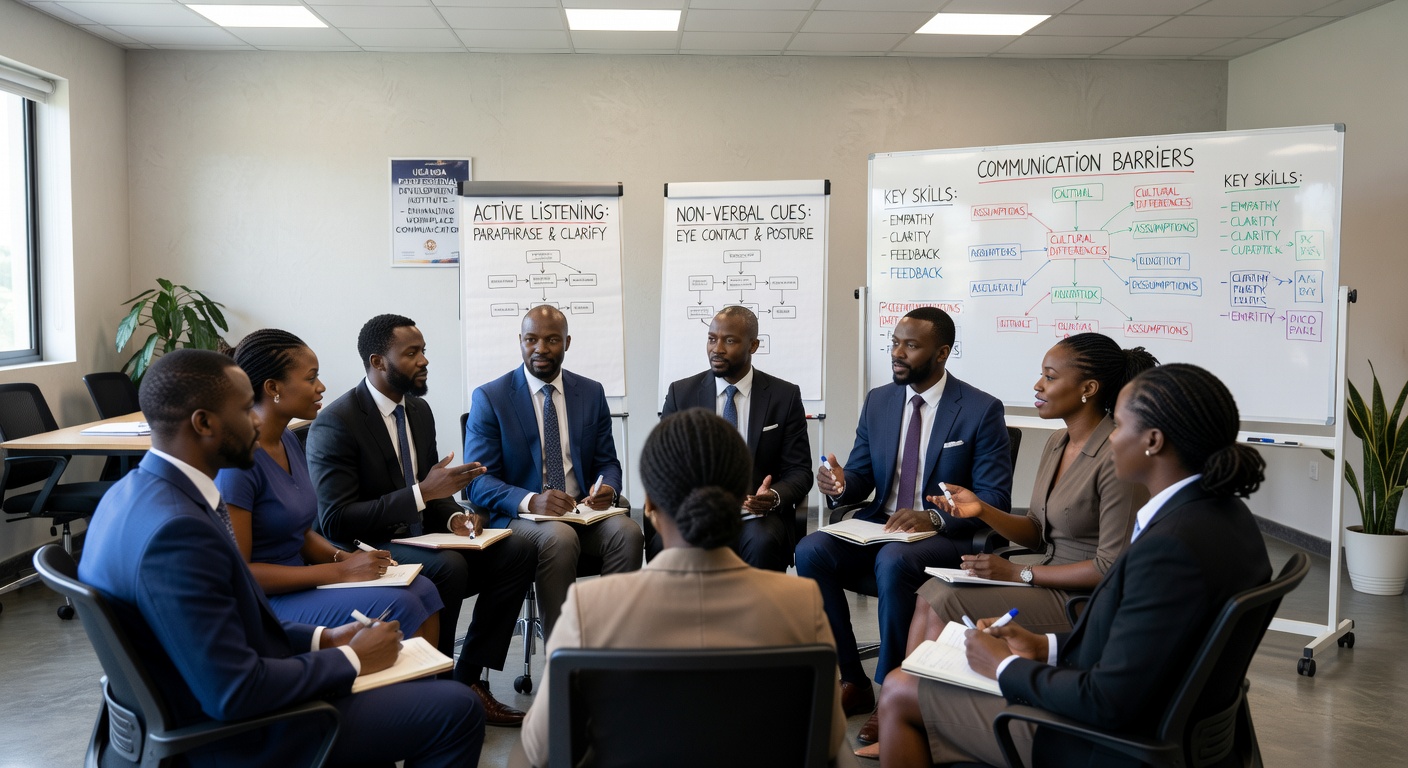
After twelve years of coaching professionals across Uganda's private, public, and civil society sectors, certain patterns emerge with striking regularity. The gap between a competent manager and a truly exceptional leader is rarely about technical skill. It's almost always about something more fundamental — how they think, communicate, and relate.
In this article, I'm sharing the five most common and consequential leadership gaps I see in Ugandan mid-level managers — and what closing each gap looks like in practice.

1. The Delegation Deficit
The most common pattern I observe is managers who are extraordinarily busy but not particularly effective. When we dig into the root cause, it's almost always the same: they are doing too much themselves and delegating too little.
This pattern is deeply understandable. Many Ugandan managers have risen through the ranks because of their exceptional individual performance. Their identity is tied to doing excellent work themselves — not to enabling others to do excellent work. The shift from doer to enabler requires a complete rethinking of what "contribution" means.
"A manager who does everything themselves has a team of one. A manager who delegates well has a team of many."
Effective delegation isn't about dumping tasks on people — it's about matching the right tasks to the right people with the right level of support, and then getting out of the way. It requires trust, and trust requires vulnerability. That's often where the real work begins in coaching.
2. Conflict Avoidance
Uganda's professional culture tends to value harmony and respect for authority — which are genuinely beautiful and important values. But when these values become barriers to honest conversations, they create slow-burning organisational crises.
I regularly see managers who allow underperformance to go unaddressed for months because they don't know how to have the conversation. They tell themselves it will resolve itself. It doesn't. The cost — to team morale, to productivity, and ultimately to the manager's own credibility — is enormous.
Key Insight
Avoiding difficult conversations is not kindness. It is a form of negligence. When you fail to address a problem, you deny the person the opportunity to improve — and you signal to the rest of your team that standards are negotiable.
The skill we work on in coaching is distinguishing between confrontation and accountability. Honest, caring, direct feedback delivered with respect is not confrontation — it's leadership. It is something that can be learned, practised, and eventually mastered.
3. Reactive Rather Than Strategic Thinking
Many mid-level managers spend their days reacting: responding to emails, attending meetings, solving immediate problems. By Friday, they wonder what they actually accomplished. This is the trap of busyness without progress.
The shift to strategic thinking requires deliberately carving out time for reflection, horizon-scanning, and proactive planning. It requires asking "what should I be working on?" before diving into "what needs to happen right now?" — and it requires the courage to protect that strategic time even when everything feels urgent.
4. Underdeveloped Emotional Intelligence
This is perhaps the most impactful gap — and the one most rarely acknowledged. Technical competence got most managers to where they are. But at the level of leading people, emotional intelligence (EQ) becomes the primary differentiator.
EQ encompasses self-awareness, self-regulation, empathy, and social skill. Managers with low EQ tend to misread their team's motivations and morale, react disproportionately under stress, struggle to inspire rather than just direct, and leave people feeling unseen and undervalued.
5. Insufficient Investment in Self
The final and perhaps most foundational gap is this: most mid-level managers are so focused on delivering results that they neglect their own development. They read no books. They attend no courses. They never seek coaching or mentorship. They are consuming their professional capital without replenishing it.
The best leaders I have ever coached share one attribute: they are learners first. They are curious, humble, and committed to continuous growth — not as a nice-to-have, but as a professional duty.
Closing the Gaps
These five gaps — delegation, conflict avoidance, reactive thinking, emotional intelligence, and self-investment — are not character flaws. They are learnable skills. Identifying them honestly is the first step. Working intentionally to close them, ideally with structured coaching, is the path forward.
If you recognise yourself in any of these patterns, that recognition is itself a sign of self-awareness — which is exactly where leadership development begins.
Grace Kiwanuka is the founder and lead executive coach at Ascend Consulting Uganda. She has coached over 500 Ugandan professionals across all sectors. To book a complimentary discovery session, contact us here.